The person the board trusts, without the spreadsheets.
You are responsible for one of the organisation’s largest costs and given the authority for none of it. Here the homework is already done: the queue brings you only what needs a person, and the story you take to the board is defensible to the last decimal without your having built it.
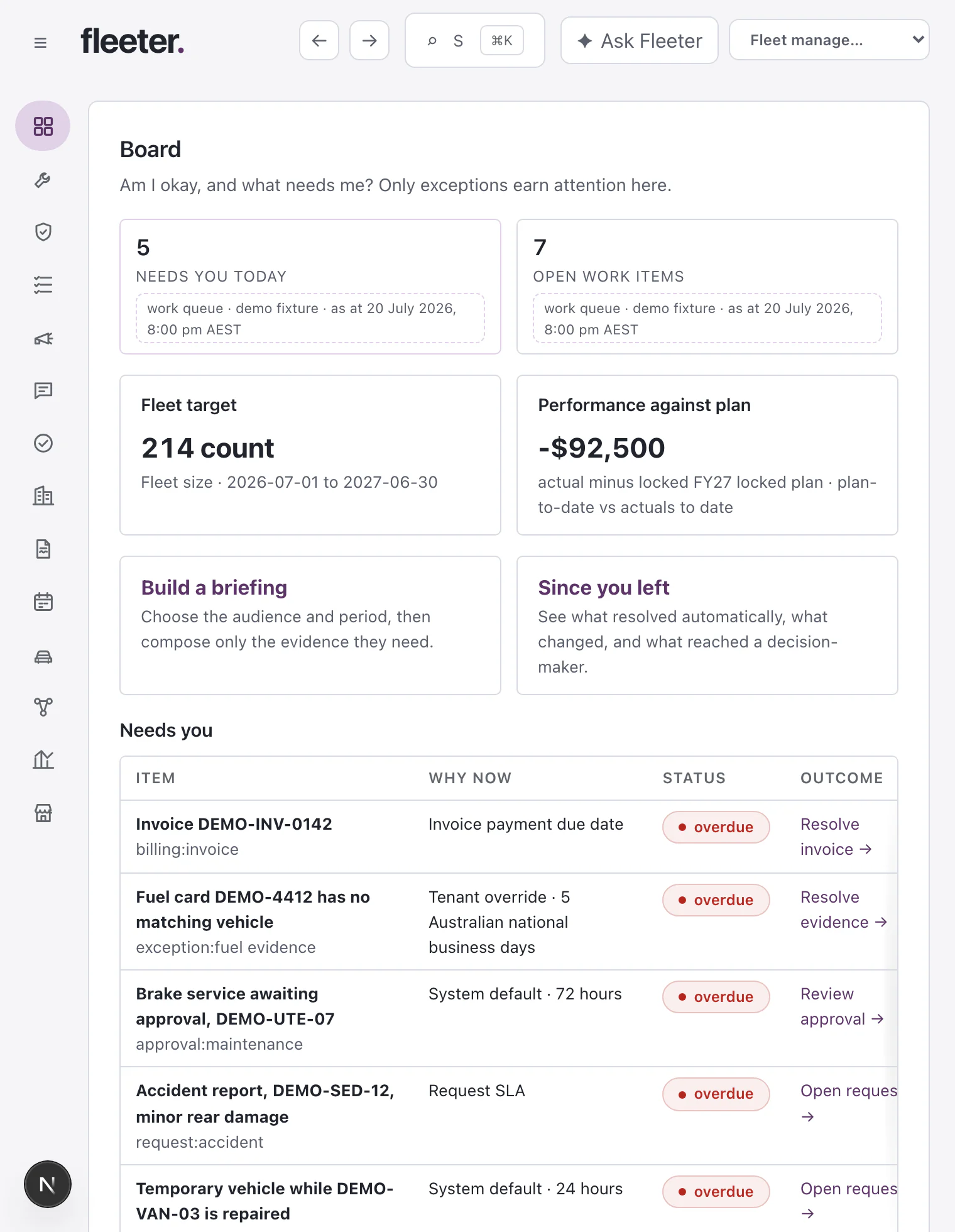
The Board, as it is built. Sample data, not a customer’s.
Chasing things that a system should already know.
Registration renewals across four logins. A fuel bill reverse engineered in a spreadsheet. Being the human rules engine every request has to pass through. And every March, the FBT fire drill.
All of that is downstream of one thing: nobody kept a proper record of the vehicle. Fix the record and most of the work stops existing rather than getting easier.
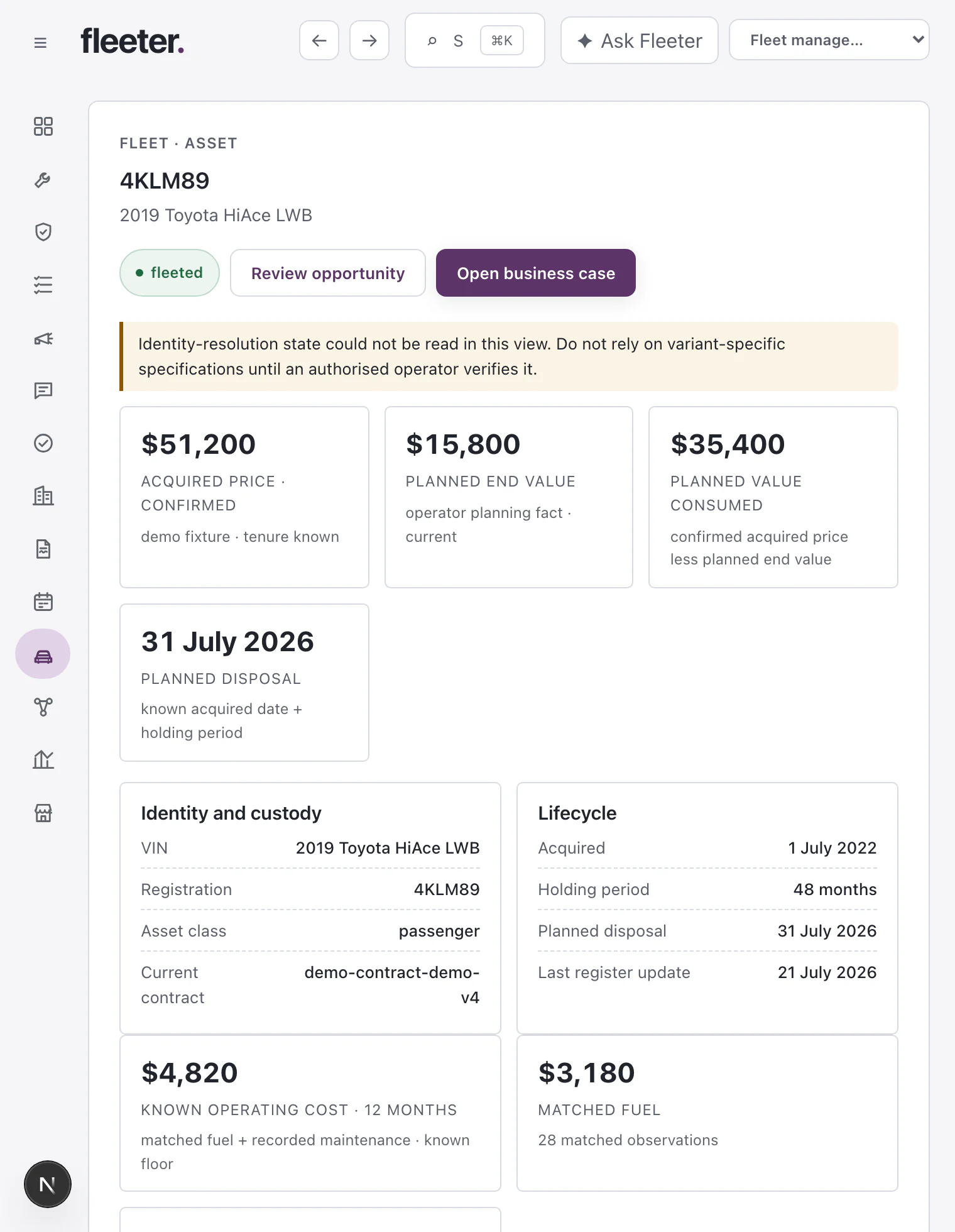
Your fuel card is already understood. So is your bowser.
The record is built from what you already have, not from a data entry project. Fuel card statements from BP, Ampol, Shell, WEX and Motorpass are read as they come from the provider, in CSV, spreadsheet or PDF. Fuel issued from your own depot bowsers counts too, matched to the plant number your people actually use.
From there the evidence stacks up on its own: GPS traces and trip data from Geotab, odometer readings that fall out of every matched fill, service invoices from the workshop that did the work, and logbook trips a driver classifies in ten seconds. Each one lands on the vehicle with its source and date, and each one makes the next number harder to argue with.
- BP Plus and BP Fleet, Ampol StarCard and FleetCard, AmpolCard PDFs, Shell Card, WEX and Motorpass
- Depot bowsers and in-house fuel logs, matched on the plant number
- Geotab trips and traces as evidence, with the vehicle identified per trace
- Registers with trucks, compactors and plant keep their VINs and plant numbers on import
One number tells you whether you are okay.
Open the Board. Three of two thousand need you today. Work the queue top down, each item expands in place with everything already on the card, and one key acts on it. When it says zero, close the tab.
No streaks, no badges, no engagement. The measure of this screen is how little time you spend on it.
When you would rather ask than click, Ask Fleeter answers from your own record in plain words. It can look things up freely. It can only change something by writing out a plan that you confirm, and the audit line says so.
- The compliant majority clears itself and never reaches you
- Board policy becomes a rule set: caps, safety minimums, emissions gates
- You draft freely, and nothing goes live until a second person activates it
- What resolved without you is still visible, so you can prove it did
The FBT year, kept as it happens.
A logbook period opens for a vehicle and a driver, runs its twelve weeks in your own time zone, and every trip in it is classified as it happens rather than reconstructed in March. The odometer brackets each end. When the period closes the report prints, and the business use percentage is a fact the FBT return relies on for the next five years.
Declarations, contributions and exemption tests run per contract, per year, and the ones that need a person are the only ones you see.
A recommendation that leads with reasons, not a score.
When a lease matures you land on a prepared decision. The recommendation says why in plain words, states its watch outs just as plainly, and every option ruled out shows its reason and stays on the page.
Choose against the recommendation and you are asked for a sentence. Both are recorded, so three years later your judgement is still defensible.
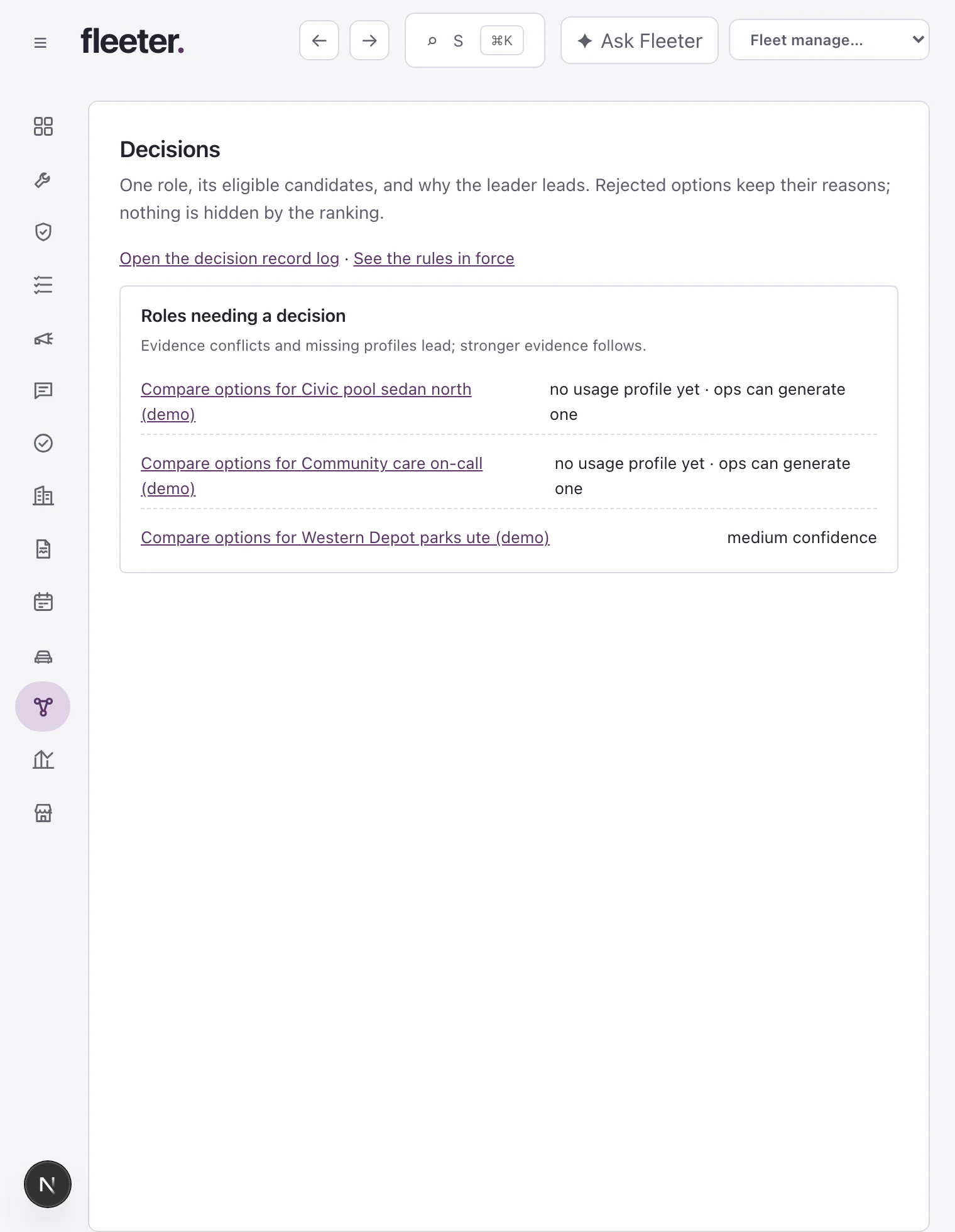
Start on a card. Grow on one line.
Six dollars a vehicle a month, and it only ever falls as the fleet grows. A council with a hundred vehicles pays the same rate per vehicle as a fleet management organisation with five thousand, because it is the same platform. There is no step where the bill jumps because you crossed a threshold: every band prices only the vehicles inside it, from ten vehicles to twenty thousand.
What you do not get at the small end is people. Implementation, integrations, governance and a named support line begin at the assisted tier, and that is a deliberate line rather than a paywall. The whole schedule is published.
Plan the role, not the vehicle.
Every vehicle is filling a role. Fleeter learns what each role truly demands from your own fuel, trips and usage, then fills it the way you choose to run: safest, cleanest, lowest capital, or lowest whole of life cost.
That is the forward fleet: the fleet you should be running, kept live beside the one you do, and recomputed as the evidence arrives. When the board asks, one tap turns the quarter into a briefing with every figure traced to its source.
The same evidence carries your emissions position: Scope 1 from every matched fuel line, Scope 2 from metered charging, and the energy supply slice of Scope 3, all on a version pinned Australian factor set with the exclusions shown on the page rather than buried in a footnote.
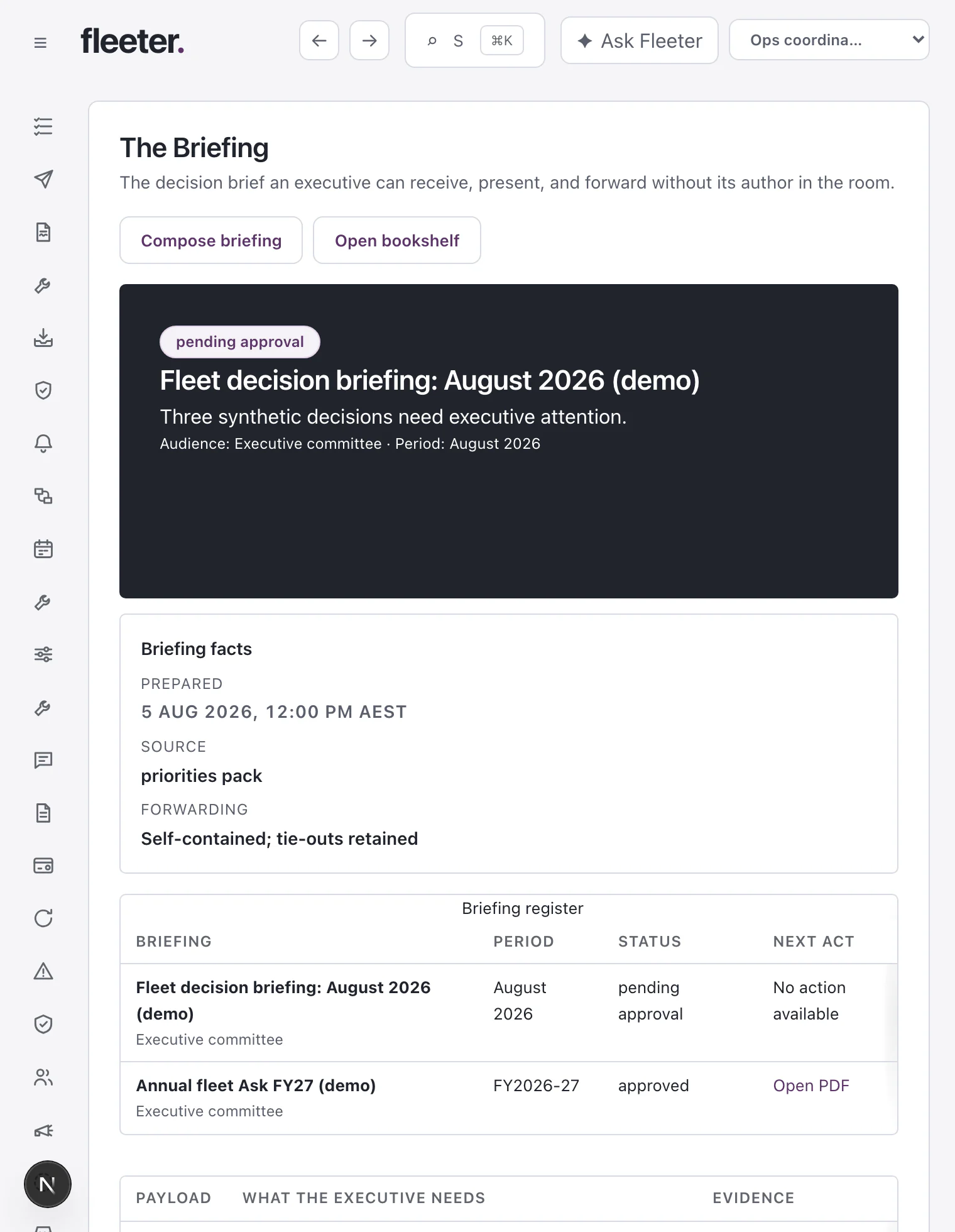
Bring a fuel card statement. See your forward fleet.
One statement is enough to baseline the fleet; add your asset register when you have it. Card numbers are blanked the moment a file is read, and nothing touches your live systems. The assessment is free; if you decide to run the fleet here afterwards it is six dollars a vehicle a month.