The FBT year should not be an event.
Novated is a volume business with a compliance tail, and the tail is what actually limits how many employers you can carry. On Fleeter the quoting, the contracts, the payroll postings, the declarations and the FBT position live on one record per vehicle, under your brand, with the assistant answering the questions that used to ring the desk. The book grows, the back office does not have to, and what you build is evidenced to the last deduction.
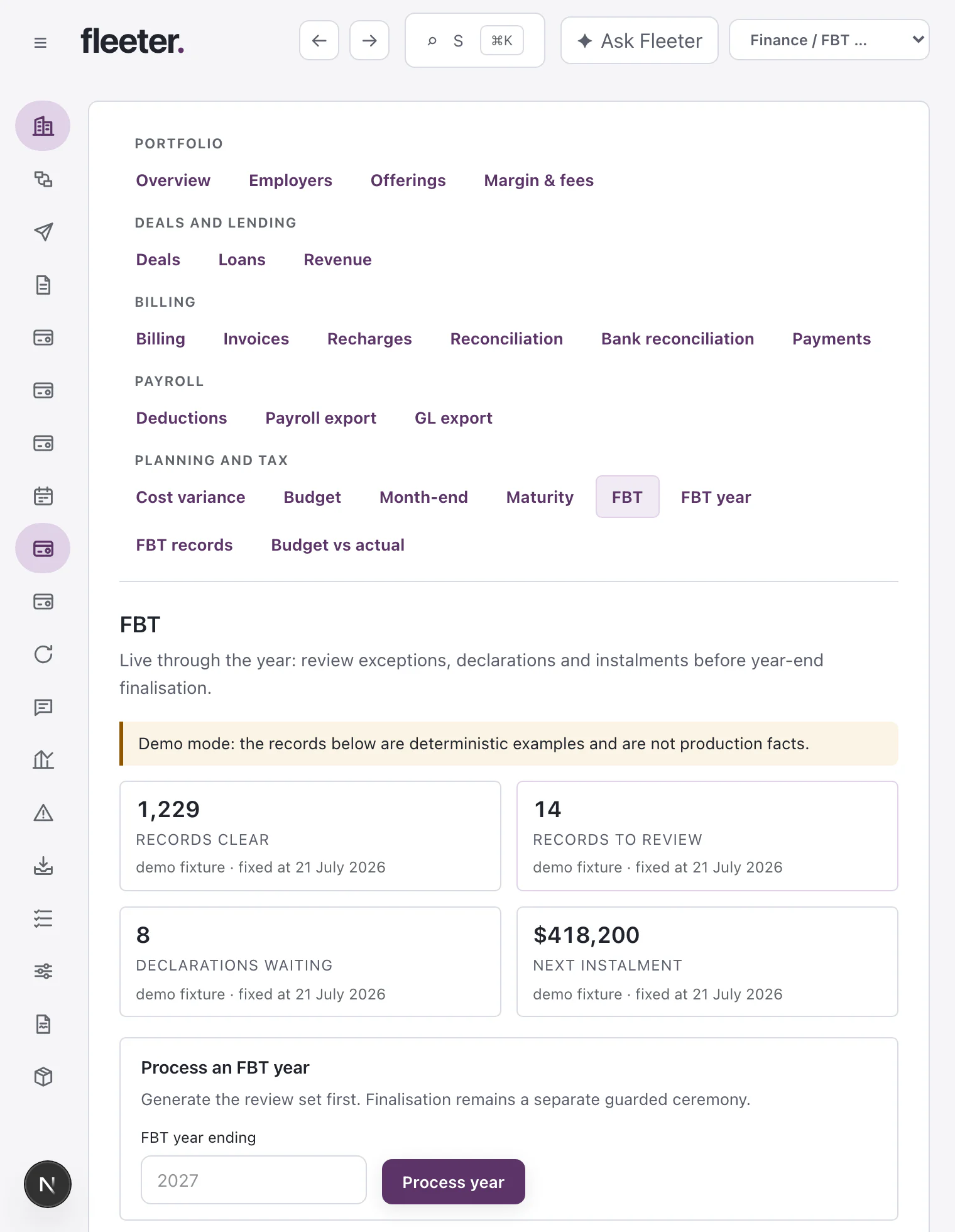
The FBT position, as it is built. Sample data, not a customer’s.
Every contract carries a decade of small obligations.
A novated lease is a three way arrangement that has to stay correct for four years across an employer’s payroll, a financier’s ledger, a driver’s life and the ATO’s rules, while all four of them change.
Most of the industry manages that with spreadsheets, a shared inbox and the memory of two people. It works right up until it does not, and the failure mode is a restatement rather than an outage.
- Deductions posted per employer, in the employer’s own format
- Employee contributions tracked against the elected method
- Declarations chased automatically, then escalated, then recorded
- Exemption eligibility tested per contract per year, not assumed at origination
- Logbook periods that run in the driver’s own time zone, trips classified as they happen, the report printed when the period closes
The opaque quote is the thing your market hates most.
One savings number, with the interest, the margin and the fees folded in where nobody can see them. There is no standardised comparison rate in this market, which means a transparent quote is a competitive weapon rather than a courtesy.
Quotes you build here itemise by default: the cost of the money, the margin, the fees and the running costs on their own lines, with the tax benefit shown separately. You choose whether to show it. The record keeps it either way.
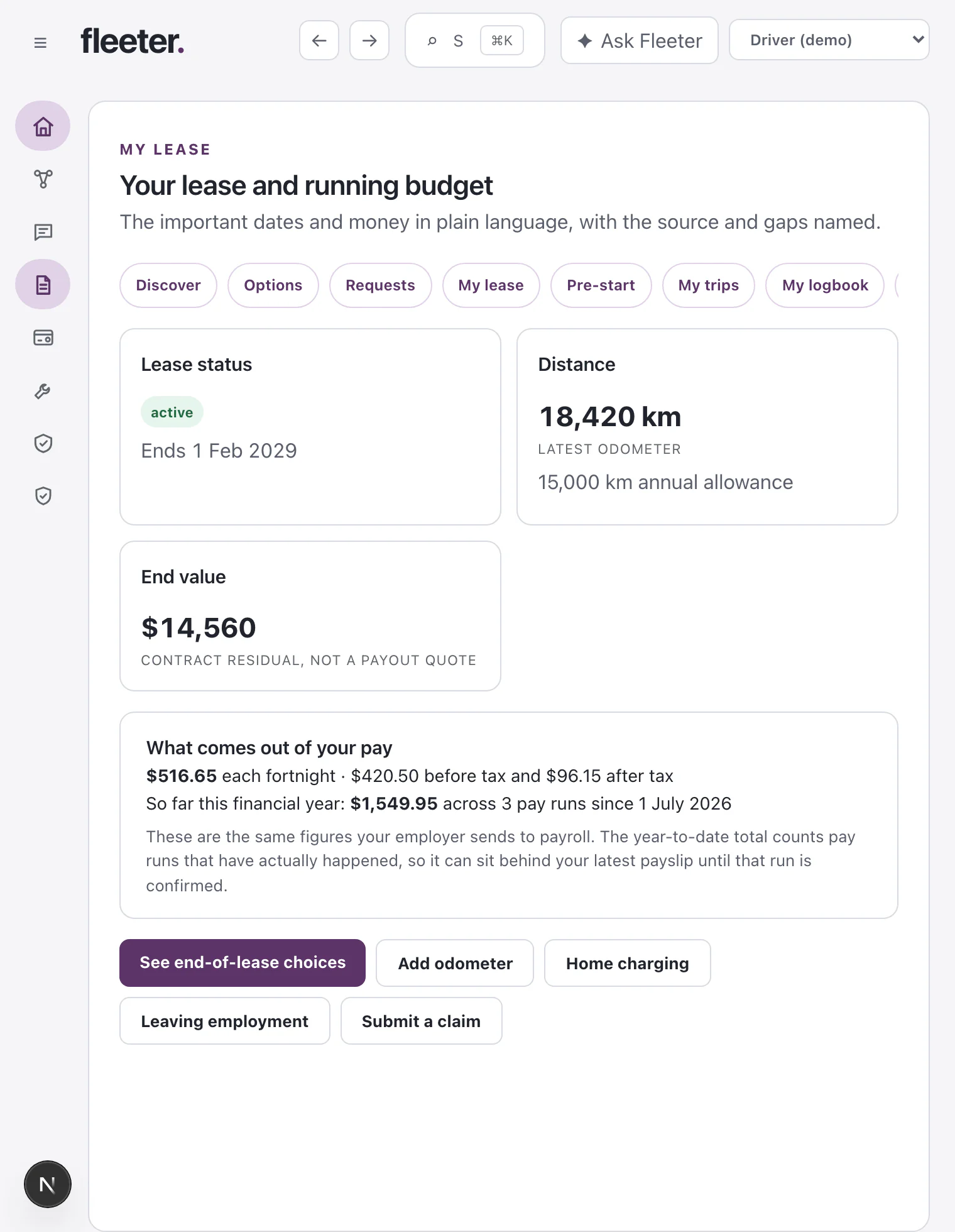
Give the driver their own answers and the phone stops.
Most inbound is a driver asking a question the system already knows: what came out of my pay, what is left in my budget, when is my service, how do I claim this.
Every driver gets their own view of their own vehicle, in plain language, and the small things they can do without a person. And under your brand name, the assistant answers the plain questions from the driver’s own slice of the record and nothing more, handing anything it should not answer to your team as a logged request. Your people get the calls that actually need a person.
Grow the book without the back office pressure.
Inside the operation the assistant reads the same record and acts only through a plan a person confirms: import these vehicles from the attached file, analyse this bill, prepare the next step. It is off for every tenant until you turn it on, read only first if you prefer, and it runs under a processing policy, a retention period and a budget you set. A fully private model deployment is built in for organisations that require it.
- Answers under your brand, within each person’s own scope, never beyond it
- Acts only through a plan the same person confirms, which expires unused
- Off by default, read only if you choose, budgets and retention under your control
The FBT substrate comes across intact, or the migration is not done.
A novated migration fails quietly when the logbooks, the odometer readings at each FBT year boundary, the declarations and the year to date contributions do not come across, because most of them live outside the incumbent platform in PDFs, portals and email. Fleeter’s intake is built for that input: a census of what was received, extraction with the source recorded on every field, a golden record per vehicle and contract, a variance report against what you run today, and a reconciliation you sign before anything is promoted.
Every load is re-runnable from the same dump, so a full volume rehearsal is something you do more than once. Nothing is guessed and nothing is silently dropped.
A book that is worth more because it can be proved.
A novated book is valued on what can be shown about it: that every contract is what it says, that every deduction posted in the employer’s format, that every declaration was chased and recorded. Most providers reconstruct that picture for a buyer, a funder or a regulator after the fact.
Here the proof is a by product of running the business. Every entry carries its source, nothing is edited, and the record exports in open formats whenever you choose. Compliance costs less along the way, and the business is easier to sell, to fund or to hand on.
Send HR a page written for them.
When an employer’s HR team asks what the program will cost them to administer, the answer is a page you can send them: the employer page is written for the person who signs, not the person who sells.
Prove it on one employer book, beside what you run today.
Nothing of yours moves. We run one of your employer books beside your current system through a full cycle, quote to finance to contract to payroll to FBT, and you compare the outputs line by line before anyone discusses a migration.
It measures your own touches per transaction and turnaround while it runs, so the business case is built from your numbers rather than ours. If the outputs do not reconcile, you have lost a fixed fee and learned something. That is the whole point of doing it in this order.
- Your book, your employer, your payroll formats
- Run in parallel. Nothing live is touched and nothing is cut over
- Outputs compared against your current system, not against a demo
- Migration quoted afterwards as a fixed scope, or not at all
One engine, your surface.
The audited domain logic underneath is the same for everyone on the platform. Only the surface changes, and accessibility and compliance critical interface elements are a core that no skin can override.
Non car packaging is priced separately and charges for actively packaged employees rather than everyone eligible.
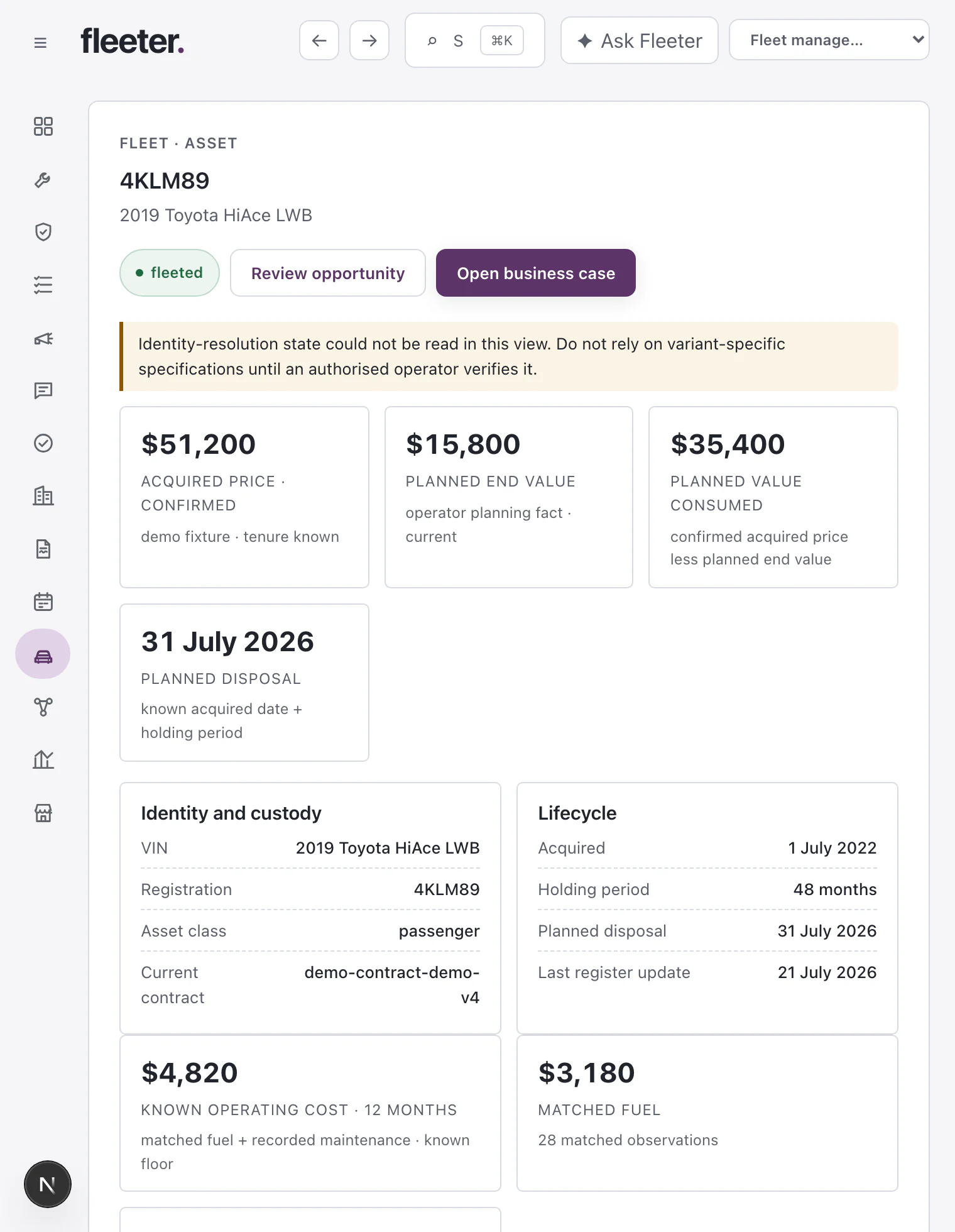
Bring one employer book.
We will walk the whole lifecycle on real shaped data: quote, finance, contract, payroll, FBT, end of lease, and show you where your current process is carrying risk you cannot see. The packaging baseline is $12,500 for one employer book, and it is credited in full against implementation.