You are lending against an asset you have never seen.
A VIN, a valuation table and a promise. That is what most vehicle finance is written on, and it is why the whole industry prices the uncertainty rather than the asset. Fleeter holds the actual record of the actual vehicle, for its whole life.
This surface is in build. What follows is the shape it takes, shown now so the people who will use it can tell us where it is wrong.
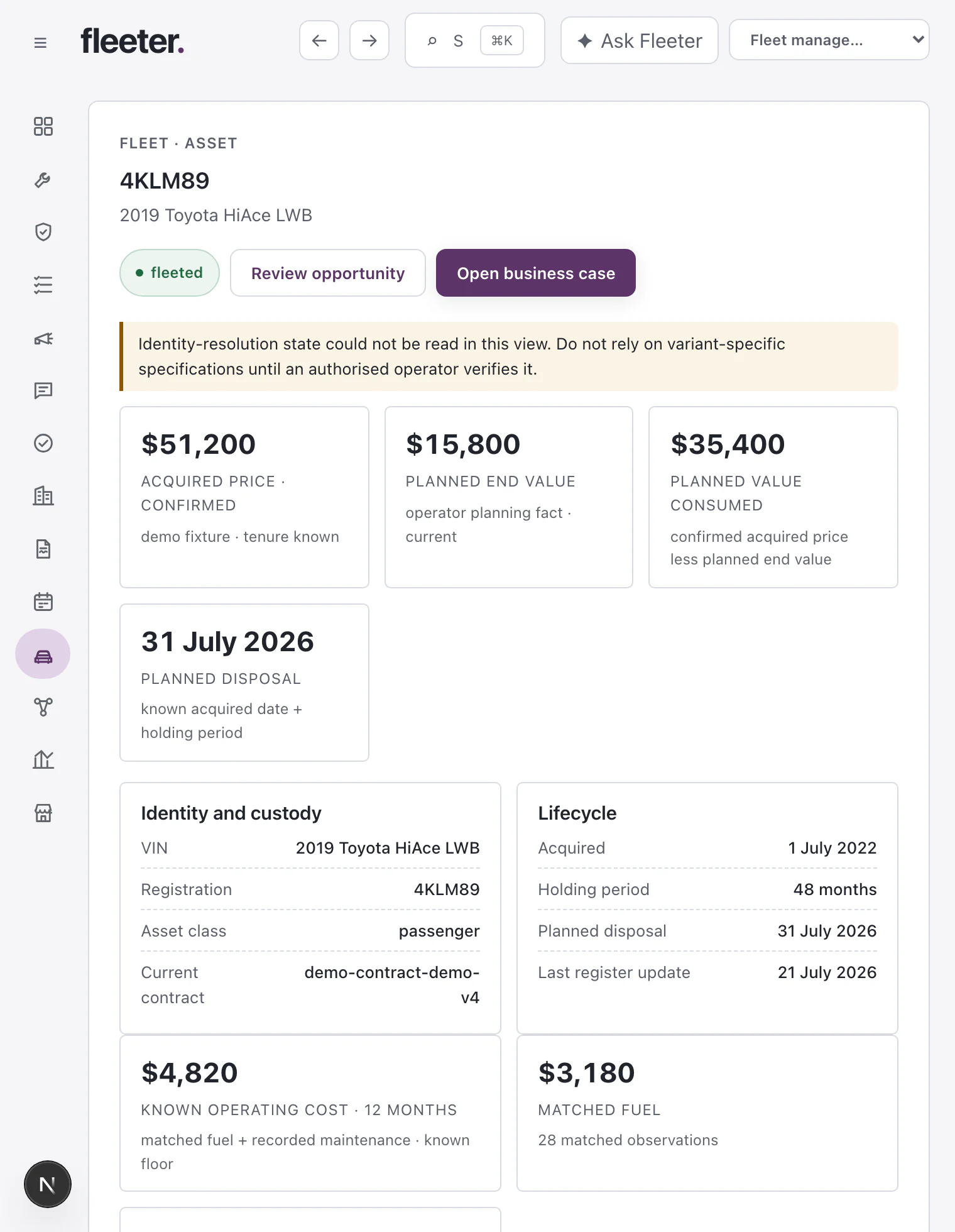
The lender view, as designed. Sample data, not a real application.
The panel side is built. The lender side is not, yet.
Being straight about the state of it: versioned financier profiles, criteria and rate cards, per lender eligible, refer or ineligible with named reasons, and commission agreements versioned per organisation and product with an immutable snapshot frozen at acceptance. All of that runs today, from the operator’s side.
What does not exist yet is your side of the glass: your own portal, your own applications, your own settlements. That is what we are building, and it is why this page is an invitation rather than a pitch.
- Structured applications, comparable across a panel rather than reformatted per lender
- One live application per quote, enforced in the database rather than by convention
- Decisions recorded with their reasons, on both sides
- Settlement evidenced end to end, in the same record the asset lives in
Ownership chain, service history and odometer evidence, per VIN.
Every vehicle carries its own record: what it cost and whether that is confirmed, who has owned and held it and when, every service with the invoice content hashed, odometer readings with their source and date, and the compliance position.
Where the record is partial it is labelled, not smoothed over. A gap you can see and price is worth more to you than a clean looking field somebody typed.
A residual position built from evidence rather than a table.
Residual risk is the single largest uncertainty in the book, and it is currently set from published tables adjusted by judgement. The record holds the actual inputs: real duty patterns, real condition, real maintenance history, real resale outcomes for comparable cohorts.
We are not asking you to take our number. We are proposing you get to see the evidence behind whatever number you set, per asset, at origination and for every year after it.
Your panel terms and your document set, built in.
A small number of lenders shape this surface before it ships: what an application has to carry, what a decision has to record, what settlement evidence you need to hold, and what your credit team needs to see on one screen.
In exchange you get the surface built to your process rather than to our assumptions, and the integration work done once rather than retrofitted.
Tell us where this is wrong.
We would rather hear it now than ship it and find out. Thirty minutes with your credit and operations people is worth more to us than any amount of guessing, and you will see exactly what is real today.